The Biphasic Effect in Photobiomodulation: Why Too Much Light Can Be Harmful

Photobiomodulation is fascinating because of its apparent simplicity: exposing the skin to red or infrared light to stimulate the cells. But this simplicity masks a much more subtle biological reality. As with many things in the field of wellness, the dose makes all the difference. In PBM, exceeding the correct dose does not enhance the benefits—it can actually negate them.
What is the biphasic response in photobiomodulation?
The biphasic response describes a specific relationship between the dose of light received and the cells’ reaction. At low intensities, the stimulation is beneficial: the cells become active, produce more energy, and respond favorably. But beyond a certain threshold, the effect reverses. An excessive dose inhibits cellular activity rather than enhancing it.
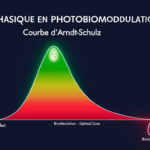
This phenomenon is based on Arndt-Schulz’s law, formulated in 1888 by Rudolf Arndt, a professor of physiology, and Hugo Schulz, a professor of pharmacology, both at the University of Greifswald. It states that weak stimuli activate vital functions, moderate stimuli increase them, strong stimuli inhibit them, and excessive doses abolish them. When applied to photobiomodulation, this law produces a characteristic bell-shaped curve: the response to the dose rises, reaches a peak, and then declines.
The Bell Curve: Visualizing the Biphasic Dose
Imagine a hill. The ascent represents the increasing positive effects of exposure to low-intensity red or infrared light. The summit is the optimal zone, where the benefits are greatest. The descent is what happens when you exceed the ideal dose: the effects fade, then disappear, or even begin to harm the body.
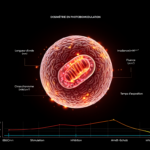
This curve can be observed at the cellular level. Cytochrome oxidase, a key enzyme in the mitochondrial respiratory chain, is the primary photoreceptor involved in photobiomodulation. At low light intensities, it absorbs photons and stimulates ATP production in the mitochondria. This increase in cellular energy supports numerous processes: tissue renewal, collagen production, regulation of oxidative stress, and densification of the extracellular matrix.
But if exposure continues for too long or if the intensity is too high, cytochrome oxidase becomes saturated. ATP production plateaus and then drops. Oxidative stress increases instead of decreasing. The desired effect is reversed.
Is it possible to do too much photobiomodulation?
The answer is yes, and this is not just a theoretical warning. Users of LED masks, LED panels, or low-intensity laser devices at home are particularly at risk. Convinced that “more is better,” some people increase the number of daily sessions or extend the duration of exposure far beyond the recommended limits.
However, the biphasic treatment does not tolerate excess. A session that is too long or uses inappropriate wavelengths can not only reduce the expected effects but also cause temporary cellular fatigue. The skin, cells, and tissues need time to process the light signal and respond positively to it. A recovery period is necessary between sessions.
The wavelengths involved also play a decisive role. The recognized therapeutic windows range from 630 to 670 nm for visible red light and from 800 to 880 nm for near-infrared light. Outside these ranges, light energy is absorbed less efficiently by cytochrome oxidase, which alters the dose-response relationship.
Low intensity, high precision: the proper use of PBM
What the biphasic response teaches us is that photobiomodulation is a precision discipline. A low-intensity laser or LED mask is not a tool that you simply leave on for a long time to amplify the effects. It is a signal sent to the cells, and that signal must be calibrated.
For facial and body treatments, consumer devices generally offer session durations ranging from 10 to 20 minutes. These durations are not arbitrary: they correspond to the ranges within which cellular stimulation remains in the ascending portion of the bell curve. Daily or even twice-daily use that does not adhere to these guidelines can produce the opposite effect of what is intended regarding collagen production, extracellular matrix renewal, or inflammation regulation.
Age is also a factor. Aging cells respond differently than young cells. Mitochondria, which become less efficient with age, may require dose adjustments to ensure optimal ATP production. This is one of the reasons why usage recommendations vary depending on individual profiles.
Frequently Asked Questions
Is it possible to do too much photobiomodulation?
Yes. Above a certain dose, the effect of photobiomodulation reverses according to the principle of the biphasic response. Excessive exposure inhibits cytochrome oxidase activity and reduces ATP production rather than increasing it. It is essential to adhere to the durations recommended by the device being used in order to remain within the beneficial range of the dose-response curve.
What is Arndt-Schulz's law in photobiomodulation?
Arndt-Schulz’s law is a principle of pharmacology applied to photobiomodulation: low doses of light stimulate cellular activity, moderate doses optimize it, and high doses suppress it. It explains why the biphasic dose is central to any effective use of PBM, whether with a low-intensity laser or an LED mask.
What is the ideal duration of a photobiomodulation session?
The optimal duration depends on the device, the wavelengths used, and the area being treated. Most consumer-grade devices recommend sessions lasting 10 to 20 minutes. Exceeding this duration without good reason does not enhance the effects on collagen production or the extracellular matrix; on the contrary, it may cause cellular photoreceptors to become saturated.
Does the frequency of sessions have an impact on the biphasic effect?
Yes. Using the device too frequently—without giving the cells time to recover and process the light signal—can mimic the effects of an overdose. One session per day, or even every other day, depending on the device’s instructions, allows the cells to fully benefit from the red or infrared light stimulation.
Do wavelengths affect the biphasic dose?
Wavelengths determine the depth of penetration into the skin and the type of photoreceptors activated. The recognized ranges (630–670 nm for red, 800–880 nm for infrared) correspond to the optimal absorption windows of cytochrome oxidase. Photobiomodulation performed outside these wavelength ranges alters the dose-response curve and may reduce the effectiveness of the treatment.
Finding the Right Balance to Get the Most Out of the PBM
Photobiomodulation is one of the most promising approaches to cellular well-being. Its effectiveness is based on a fundamental principle: respecting the biology of the cell rather than trying to force it. The biphasic response serves as a useful reminder that the body is not a machine that can be optimized without limits. It responds better to a precise signal than to excessive stimulation.
Taking the time to understand the biphasic dose ultimately means trusting the natural functioning of your cells. It’s also the best way to ensure that each session truly contributes to your well-being, session after session.
See also:

 Effet biphasique en photobiomodulation : pourquoi trop de lumière peut nuirePar Adèle, le 16 novembre 2026
- Du photon à la cellule : le voyage de la lumière en photobiomodulationPar Adèle, le 28 juin 2025
- Photobiomodulation : 8 idées reçues qui freinent son adoptionPar Adèle, le 1 septembre 2025
- 660 nm vs 850 nm : guide comparatif des longueurs d’onde les plus utiliséesPar Adèle, le 5 avril 2026
- Photobiomodulation et microbiome cutané : piste de recherche émergentePar Adèle, le 30 juin 2025
- LED rouges, lasers et infrarouge proche : quelle longueur d’onde pour quels effets ?Par Adèle, le 17 décembre 2025
- Dosimétrie en photobiomodulation : comprendre la fluence, l’irradiance et la dose optimalePar Adèle, le 28 octobre 2026
- Photobiomodulation : placebo ou preuve scientifique ?Par Adèle, le 22 janvier 2026
- Types de peau et photobiomodulation : quel impact de la mélanine ?Par Adèle, le 10 février 2026
- Photobiomodulation et mitochondries : le rôle clé du cytochrome c oxydasePar Adèle, le 9 octobre 2026