Before-and-After Photomodulation: Reality vs. Myths About Visible Results

Photobiomodulation is attracting growing interest, and there are many questions about visible results: What can you expect? How long will it take? Which areas of the face will benefit? This curiosity is understandable, as LED light treatments trigger real, documented, and gradual biological processes. Understanding what’s really happening in the skin allows you to approach each session with the right perspective and to recognize changes as they occur.
What Photobiomodulation Actually Activates in the Skin
Photobiomodulation refers to the use of LED light at specific wavelengths to stimulate skin cells. Each color of light targets specific biological processes. Red light, at around 630 to 660 nanometers, is particularly known for stimulating collagen production and promoting cell regeneration. Infrared light, at longer wavelengths (between 800 and 1,000 nm), penetrates deeper into the tissues and supports local circulation.
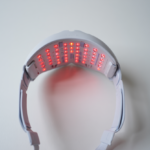
When an LED mask is placed on the face, the photons emitted by the facial LEDs interact with the mitochondria in skin cells. These organelles capture the light energy and use it to boost their activity. This promotes cell regeneration and, with it, the natural synthesis of collagen and elastin. This is not a superficial cosmetic effect—it is a measurable biological response.
Why Before-and-After Results Are Never Instantaneous
The results of photobiomodulation follow a precise biological logic, and that is precisely what makes them reliable. Skin physiology has its own rhythms, and LED light respects them by supporting the skin’s natural processes rather than forcing them.
The skin renews its cells in a cycle of about 28 days. Collagen production, stimulated by LED light sessions, takes several weeks to produce visible results. Rigorous studies on LED devices show concrete results after 4 to 8 weeks of regular sessions, at a rate of 3 to 5 treatments per week. Before this time, changes are already occurring at the cellular level, but they are not yet visible to the naked eye on the skin’s surface.
It is precisely this gap between what is biological and what is visible that encourages us to approach each session with patience and trust in the process.
Documented effects on wrinkles, acne, and scars
The findings from the data on photobiomodulation can be consistently grouped into three main areas of action.
When it comes to wrinkles and fine lines, red light works by stimulating fibroblasts—the cells responsible for synthesizing collagen and elastin. As collagen levels increase in the dermis, the skin becomes firmer and superficial wrinkles gradually fade. Studies have shown a visible reduction in wrinkles in 80% of cases after 8 to 12 weeks of regular use of LED devices.
For acne, red light supports the healing process and helps soothe irritated areas. The cellular regeneration promoted by the treatments allows the skin to recover more effectively after breakouts, resulting in a gradually more even texture.
For acne scars, the effects are slower and more gradual. The healing process involves long-term remodeling of collagen fibers. Improvements are observed, but over a period of several months rather than a few weeks.
Red light, LED mask: What Sets High-Quality Devices Apart
Not all LED devices are created equal, and this reality is at the heart of many disappointments. An effective LED mask must deliver the correct wavelength, with sufficient power (measured in milliwatts per square centimeter) and an appropriate duration of contact with the skin.
LED devices available for personal use now incorporate increasingly sophisticated technologies. LED masks available for personal use can now come close to matching the performance of certain professional devices, provided that best practices are followed: a clean face, an appropriate session duration, and regular use. The chosen light color must correspond to the desired outcome.
An LED face mask that combines red light and infrared light generally provides a more comprehensive treatment: stimulation both on the surface and deep within the skin, improving the skin’s overall quality—not just reducing wrinkles.
Side Effects and Realistic Expectations
Photobiomodulation is generally very well tolerated by the skin. Reported side effects are rare and mild: mild, temporary redness after the session, and eye sensitivity if the protective glasses provided are not worn. These effects subside within a few minutes.
However, here’s what photobiomodulation won’t do: erase a deep wrinkle in two sessions, transform skin texture in a few days, or replace a comprehensive skincare regimen (hydration, sun protection, a balanced diet). LED facial therapy is a complementary tool, not a magic solution.
Approaching the sessions with realistic expectations also gives you the best chance to observe and appreciate the true results—those that develop gradually over several weeks and reflect a real change in the skin’s cellular activity.
Frequently Asked Questions
How many weeks does it take to see results with an LED mask?
The first visible results of photobiomodulation generally appear between 4 and 8 weeks after the start of regular sessions. Cell regeneration and collagen production are gradual biological processes that do not become apparent on the skin’s surface until several complete skin renewal cycles have taken place. The consistency of the sessions is the most critical factor.
Is red light effective against wrinkles?
Red light, used at wavelengths between 630 and 660 nm, stimulates the production of collagen and elastin by fibroblasts in the dermis. With regular use over 8 to 12 weeks, visible improvements in superficial wrinkles and fine lines have been documented in numerous studies on LED devices. Deep wrinkles respond less quickly and to a lesser extent.
Can an LED mask help with acne scars?
Photobiomodulation supports the healing process by accelerating cell regeneration and promoting collagen remodeling. For acne scars, the effects are measurable but require several months of regular use. Results vary depending on the depth and age of the scars.
Are there any side effects from using an LED face mask?
Side effects of photobiomodulation are rare and mild. A slight, temporary redness may appear after the session but will disappear within a few minutes. It is recommended to wear the eye protection provided with the LED mask to prevent eye sensitivity. Photobiomodulation has no known adverse effects when used as recommended.
What wavelength should you choose for a cosmetic treatment on the face?
Red light (630–660 nm) is the standard wavelength for stimulating collagen production, reducing wrinkles and fine lines, and supporting skin regeneration. Infrared light (800–1,000 nm) acts more deeply on circulation and subcutaneous tissues. An LED mask that combines these two light colors offers complementary benefits for a comprehensive approach to skin wellness.
Taking your time means respecting your body's natural rhythms
Photobiomodulation is based on a fundamental principle: supporting the body in its natural processes by providing the light energy its cells need to function better. It is not a promise of instant transformation; rather, it is an invitation to support the skin’s natural processes over the long term.
Understanding this biological process is what allows us to avoid being disappointed by results that take time to appear, and to fully appreciate what is actually happening beneath the surface.
See also:

 Photobiomodulation : 2 semaines pour améliorer naturellement votre sommeilPar Adèle, le 20 mars 2026
- Comment choisir son casque de photobiomodulation pour la repousse des cheveuxPar Adèle, le 26 juin 2025
- Photobiomodulation à domicile : check-list sécurité pour débuterPar Adèle, le 23 octobre 2025
- Photomodulation avant-après : réalités vs fantasmes sur les résultats visiblesPar Adèle, le 2 novembre 2026
- Photobiomodulation : combien de séances faut-il pour voir des résultats ?Par Adèle, le 14 octobre 2026
- Photobiomodulation : journal de bord d’un utilisateur après 3 mois de cure quotidiennePar Adèle, le 26 octobre 2026
- Photobiomodulation : dangers, contre-indications et idées reçuesPar Adèle, le 22 juillet 2025
- Photobiomodulation visage : avant-après d’une cure anti-âgePar Adèle, le 23 juin 2025